

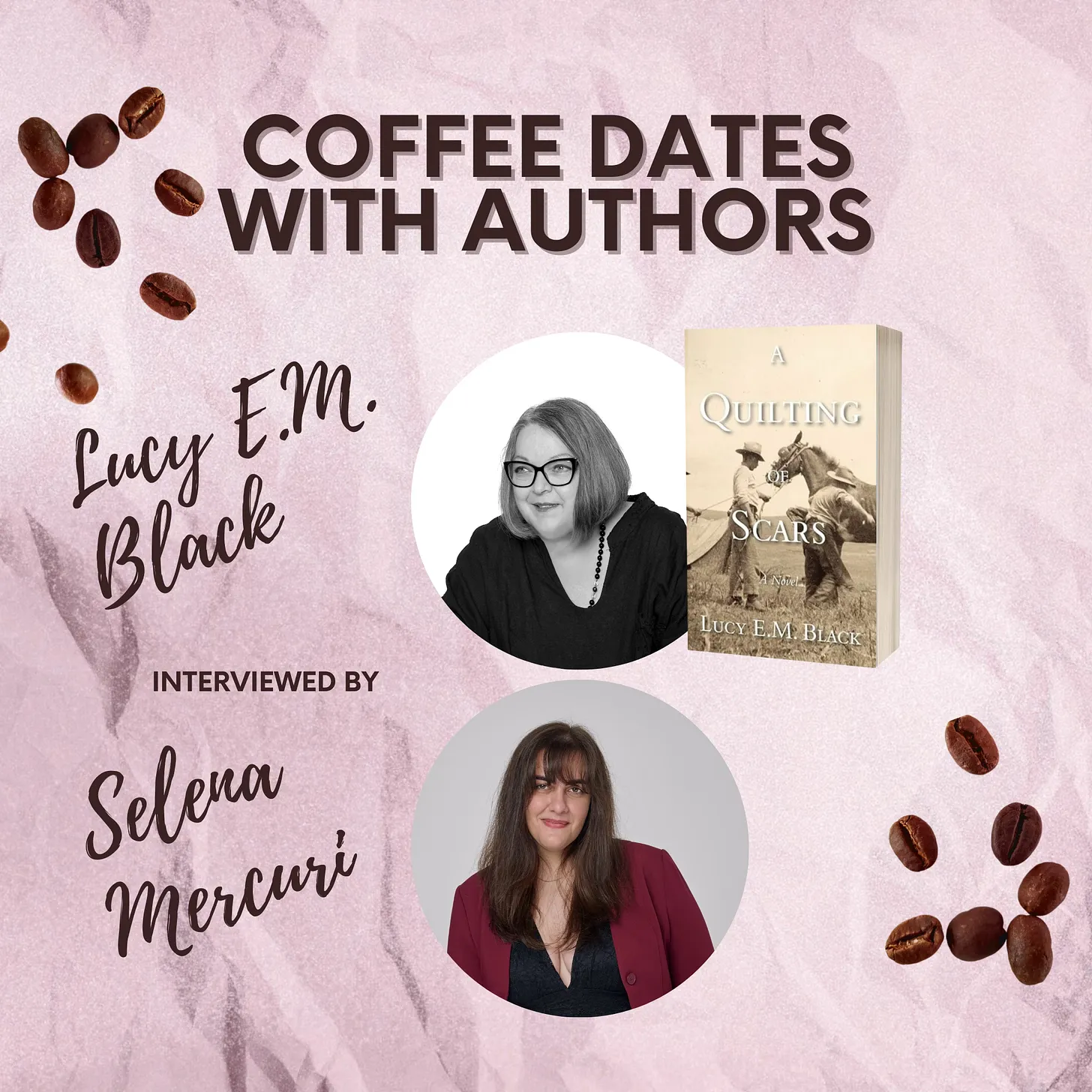
A Coffee Dates with Authors: Selena Mercuri Interviews Lucy E.M. Black
A Coffee Date with Lucy E.M. Black: Author of A Quilting of Scars

Paint a picture of your favourite coffee shop for writing. What makes it perfect to you? Is it the corner table, the barista who knows your name, the way the light hits at 2pm?
One of my favourite spots is the historic Piano Café in Port Perry. It’s an intimate café with a great menu, an effervescent owner, and delightful wait staff. The décor includes gorgeous wallpaper with a historic vibe, a fireplace, and semi-open kitchen/bar. There’s indoor and outdoor seating, private tables in the back, and tables in the front window that look out on the busy shopping street. Everything about it is comfortable and welcoming.
You’re at the counter. The barista knows your order by heart. What are you getting? Be oddly specific.
I love a pot of green tea along with their famous Sticky Toffee Pudding. Their Sticky Toffee Pudding is oozing with rich, sweet goodness and yet the cake part itself is surprising light and fluffy. It is served warm with a huge dollop of fresh whipped cream.
You’re sitting across from me now, coffee (or other beverage) in hand. Tell me a bit about yourself and your latest book.
A Quilting of Scars is my sixth book. It’s a work of historical fiction which is the genre I find myself returning to often. The main character is an aging farmer named Larkin. Larkin is a single gentleman who loves horses and who has kept a number of important secrets throughout his life. As a result of the burden of those secrets, he has lived a fairly solitary existence. The novel unspools during the course of one long day and night as Larkin is remembering. The book is a love story of sorts and a celebration of male friendship. The story is placed at the end of the 19th century when small-town Ontario was still very much under the influence of Victorian ideology. While this was a period of tremendous growth with advances in science and technology, the social mores were much slower to change. Placing the story in rural Ontario allowed me to celebrate all that was remarkable about that period of farming history while also showing the treatment of such things as breast cancer, prostitution, homosexuality, child abuse, and murder.
You notice I’m scribbling your social media handles and website on receipt paper (old barista habit). What should I write down so readers can find you?
My website is https://lucyemblack.com
I put out a monthly newsletter filled with mini book reviews, my book news, an artist of the month feature, and other interesting bits including new recipes I’ve tried. People can subscribe to this for free.
Facebook is LucyEMBlack
Instagram is lucyemblack
I also write book reviews for The Miramichi Reader in order to help promote Canadian writers. And I co-ordinate an author’s speaker series called Heart of the Story here in Port Perry. Details of our events are posted on my website and social media.
I’m that friend who always asks ‘what should I read next?’ What are your top three current reads that you’d practically force into my hands, and why is each one consuming your thoughts?
William Kaplan’s 2017 Book, Why Dissent Matters: Because Some People See Things the Rest of Us Miss, continues to be extremely relevant and a must-read for anyone who cares about free speech and truth-telling. Kaplan encourages readers to interrogate their own beliefs and values in ways that will encourage important dialogue about democracy and the social contract. Accessible language, fabulous examples of key events in our history, and thought-provoking throughout.
Jaime Black-Morsette’s book, REDress: Art, Action and the Power of Presence, is a moving anthology of work documenting first-hand accounts of historical and ongoing colonial violence against Indigenous girls, women and Two-Spirit individuals. The REDress project documents the use of art installation to bear witness to the rippling pain of Missing and Murdered Indigenous girls, women and Two-Spirit individuals. An important book on social justice—compelling and heart-breaking.
Karin Wells’s Women Who Woke Up the Law: Inside the Cases that Changed Women’s Rights in Canada. An important historical overview of ten legal cases that advanced women’s rights. Wells demonstrates that incremental change only took place after incredible sacrifice, advocacy, and perseverance. This book belongs in every library.
These are three recent reads that I found incredibly helpful in terms of my own understanding of key matters that currently occupy my thoughts. I attempt to read widely, and you can always find a good thriller in my TBR pile and piles of books by Canadian writers published by small independent presses.
The coffee shop WIFI just went down, so we’re stuck here talking. Tell me the weird, unexpected, or completely ridiculous path that led you to become a writer.
I wrote my first novel when I was in grade two. It was a detective novel called, The Great Mumbo, written in pencil in a Hilroy scribbler. I had what I now know recognize as a gifted teacher who loved the novel and had me read it aloud to my class. I was incredibly shy and hated being at the front of the room. But as I read aloud, I became more confident and my classmates laughed and clapped and congratulated me. For a brief period, I was a class celebrity, and I was hooked. I was utterly blown away by the power of my words to elicit such reactions, and so I never stopped writing. I had several successful careers and worked as an administrator, a training manager, a teacher, and a high school principal. But I continued to write in my down time and published short stories in journals and magazines. I had a brush with cancer several years ago, took early retirement, and was fortunate to have two books published in that same year.
I’m timing you with my phone’s stopwatch. You have exactly 50 words to describe your writing ritual or process. Go!
When the house is completely quiet and everyone is asleep, I go to my writing room and begin to work. I typically write from 11 p.m. to 3 a.m. daily, without fail. If I’m not actually writing a first draft of something new, I may use that time to edit or do research.
You’re hosting a dinner party and can invite any of your characters. Who’s getting the invitation, and what are you serving? (Bonus points for pairing their personality with the menu).
I would invite Larkin to dinner, as I know he would appreciate a hearty farm-style meal. I would serve pork tenderloin and chopped mushrooms wrapped in bacon and cooked in puff pastry, along with creamy mashed potatoes and steamed broccoli and asparagus (dripping with butter and a sprinkle of cheese). The pork dish is a little fancy for Larkin’s tastes, but I would want to do something just a bit special for him.
No appetizers for this crowd of nineteenth-century farmers—they’ll be eager to sit down and have a good feed. I likely would also put out a fresh loaf of bread with sweet butter. I know that Larkin wouldn’t enjoy anything too fussy, but he’s always hungry for plain, home-cooked food.
For dessert, I’d have cheese tea biscuits served in a small bowl with fresh maple syrup poured over the top, followed by a thick slice of warm homemade apple pie and a dollop of vanilla ice cream. For beverages, I would have a pitcher of cold milk on the table and a pitcher of cold water with mint leaves floating inside. After dessert, I would serve very strong black tea.
The person at the next table is eavesdropping on us. Let’s make them regret it. What’s the weirdest research rabbit hole you’ve fallen down that would make them raise an eyebrow?
I’m a bit like Alice in that I’m always tumbling down research rabbit holes. My last novel, The Brickworks, had me spending months learning about brickmaking and railway bridges. The research trips for that book were fascinating. For A Quilting of Scars, I did a deep dive into houses of ill repute in Collingwood, Ontario. Larkin visits one in the novel to make sure his parts are all in working order, which made for an interesting research foray.
I also learned a great deal about the early of treatment of breast cancer—and those treatments were painful and gruesome. There are also some horrific details about the branding and dehorning of cattle in the novel. So, lots to choose from. I could definitely make an eavesdropper uncomfortable.
As we’re leaving, you turn back and say something that will stick with me forever about writing, creativity, or life. What is it (no pressure)?
For me, this novel is about highlighting the vulnerability of young men like Larkin and his friend Paul. The Larkins of this world deserve unconditional acceptance and love without judgement. I hope this novel encourages readers to consider that.